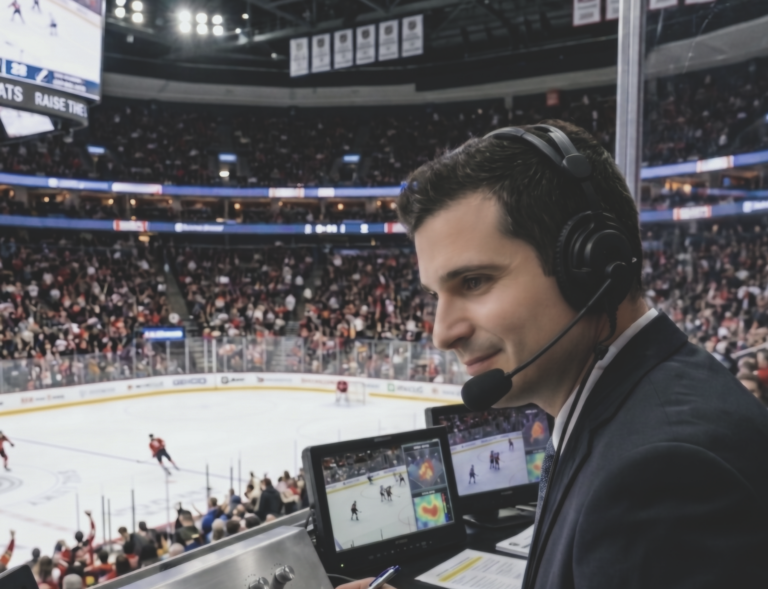
The Speed of the Game Changes Everything
Hockey moves faster than almost any other major sport. One second a team is defending in their own zone, and moments later the puck is in the back of the net at the other end of the ice.
That speed is what makes hockey exciting to watch, but it is also what makes it incredibly difficult to broadcast well.
A great hockey broadcast is not just about following the puck or identifying players. It is about anticipating moments before they happen and staying one step ahead of the action.
The Best Broadcasters Understand Momentum
The best broadcasters do this…
Most people only see the finished product.
The opening call.
The big goal.
The excitement and energy during the game.
What they do not see is the preparation that happens long before the puck is dropped.
For me, preparation has always been one of the most important parts of broadcasting hockey at a high level.
The strongest play-by-play broadcasters understand more than just the game itself. They understand momentum swings, line changes, crowd energy, and the emotional shifts happening inside the arena.
The ability to process all of that information in real time while still sounding calm, clear, and controlled is what separates good broadcasters from great ones.
Listeners and viewers may not always notice it consciously, but they can feel when a broadcaster is truly connected to the pace and emotion of the game.
Making Difficult Moments Sound Effortless
The best hockey broadcasters make difficult moments sound natural. Fast transitions, chaotic scrambles in front of the net, and sudden momentum swings all require instant reaction and precision.
At the professional level, there are no second takes.
That challenge is part of what makes hockey broadcasting so rewarding. Every game brings a different rhythm, different emotions, and different moments that need to be captured in real time.
For me, that has always been one of the most exciting parts of calling the game.
The Best Play-by-Play Broadcasters Don’t Just Call the Game. They Feel It.
Great play-by-play is more than simply describing what is happening on the ice. It is about rhythm, timing, emotion, and understanding the feel of the game.
The best broadcasters are not trying to dominate the broadcast. They are trying to bring viewers and listeners closer to the moment.
Sometimes that means raising the energy during a breakaway or overtime goal. Other times it means stepping back and allowing the crowd and atmosphere to speak for themselves.
Knowing When to Speak and When to Let the Game Breathe
One of the biggest lessons I learned over the years is that not every moment needs to be filled with words.
A huge save, a playoff atmosphere, or the crowd reacting after a dramatic goal often says enough on its own.
Part of the job is recognizing when to lean into the emotion of the moment and when to simply let the game breathe naturally.
That balance is one of the things that separates experienced broadcasters from inexperienced ones.